Survivorship has a way of humbling you.
When I rang the bell after completing treatment for Triple Negative Breast Cancer (TNBC), I believed I had crossed the finish line of one of the hardest battles of my life. Like many survivors, I carried scars, gratitude, and a renewed sense of purpose.
But survivorship doesn’t always mean the journey is over.
Sometimes it means you’ve learned how to keep walking through uncertainty with courage.
When My Body Whispered, I Paid Attention
Recently, something shifted.
My vision began to change – subtly at first, the kind of change you might blame on fatigue or stress. But something about it didn’t feel right. And as a cancer survivor who carries BRCA2 and PMS2 genetic mutations, I’ve learned that when your body whispers, you listen.
So I made the appointment.
Because my late father lived with multiple sclerosis (MS), my doctors wanted to rule out neurological causes. Vision changes can be an early sign of MS, so my ophthalmologist ordered an MRI.
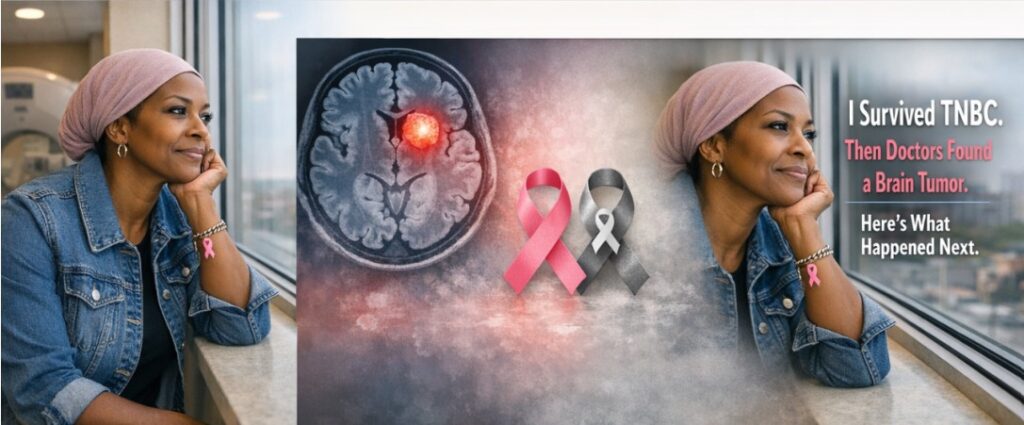
That MRI revealed something none of us expected:
A tumor near my pituitary gland. A meningioma.
In that moment, I found myself back in a familiar space – the space between relief and fear, between answers and questions, where you gather your strength and say:
Whatever this is… I will face it.
And because knowledge saves lives, I want to share what I’m learning with you.
What Is a Meningioma?
A meningioma is a tumor that forms in the meninges – the protective membranes surrounding the brain and spinal cord. Most grow slowly and are considered benign, but their location can still affect critical brain structures.
Many people live with them unknowingly because symptoms often develop gradually.
Common symptoms include:
- persistent headaches
- seizures
- hearing changes
- memory issues
- balance problems
- blurred or lost vision
Why the Location of My Tumor Matters
My tumor sits near the pituitary gland – a pea‑sized powerhouse that regulates hormones affecting growth, metabolism, fertility, and stress response.
Just above it lies the optic chiasm, where the nerves from each eye cross before sending visual signals to the brain.
When a tumor grows in this area, it can press on these visual pathways, causing peripheral vision loss – often one of the earliest signs.
For me, that was the whisper that something was wrong.
The Two Surgical Options on the Table
Because of the tumor’s location, my neurosurgical team is considering two approaches.
1. Craniotomy
A traditional method where surgeons temporarily remove a portion of the skull to access and remove the tumor.
Pros:
- direct visibility of the tumor
- full access to surrounding structures
Considerations:
- more invasive
- longer recovery
- risks of infection, bleeding, swelling, or nerve damage
2. Endoscopic Endonasal Surgery (Through the Nose)
A minimally invasive technique using instruments and a camera inserted through the nasal passages.
Pros:
- no external incision
- shorter recovery
- less trauma to brain tissue
Considerations:
- risk of cerebrospinal fluid leaks
- infection (including meningitis)
- nasal complications
- potential blood vessel injury
The final decision depends on the tumor’s size, behavior, and proximity to vital structures.
Why Pathology Matters
Imaging can’t determine whether a meningioma is benign or malignant. After removal, the tumor is examined under a microscope to determine:
- whether it’s benign or malignant
- the tumor grade
- cellular characteristics
Most meningiomas are Grade I (benign), but some are Grade II (atypical) or Grade III (malignant).
If Cancer Is Found
If malignant cells are detected, doctors must determine whether the tumor is:
- a primary malignant meningioma, or
- metastatic cancer
For someone with a history of TNBC, physicians must rule out whether breast cancer has spread to the brain. If so, it would be classified as Stage IV metastatic breast cancer, requiring a different treatment plan.
But it’s important to remember: most meningiomas are benign and unrelated to breast cancer.
The Reality of Health Disparities
I share this not only for awareness, but because disparities matter.
Research shows that Black individuals have a higher incidence of meningiomas and are more likely to develop higher‑grade tumors.
At the same time, Black women are disproportionately affected by TNBC – one of the most aggressive forms of breast cancer.
When disparities intersect with aggressive disease, communities of color face greater barriers to early diagnosis, specialty care, and lifesaving information.
This is why advocacy is not optional. It is essential.
Why I Created The Advocate’s Table
Experiences like this are exactly why The Advocate’s Table exists.
To help patients understand their health. To empower them to advocate for themselves. To close the information gap in communities where access has been historically limited. To ensure that Black, Brown, underserved, and underrepresented communities have the knowledge that saves lives.
Because every person deserves access to that knowledge.
My Brave Path Continues
When I created Surviving TNBC: My Brave Path, it was never meant to be a story about the past.
It was meant to show what survivorship truly looks like:
The uncertainty. The learning. The courage required to keep moving forward.
Right now, I’m still navigating this chapter – meeting with specialists, understanding my options, and preparing for what comes next.
But I know this:
Early detection saved my life once. Knowledge empowered my daughters. Advocacy will change the future for the next generation.
So I will keep showing up.
For my family. For my community. For every person who deserves access to the information that could save their life.
Surviving TNBC wasn’t the end of my story.
It was the beginning of my purpose.
And this brave path continues.
Join The Advocate’s Table
If this story resonates with you, share it. If it teaches you something, pass it on. If it reminds you to listen to your body, act on it.
Join me at The Advocate’s Table, where we turn knowledge into power and power into action – especially for the communities who need it most.
Subscribe. Share. Engage. Your voice strengthens this movement.

Leave a Reply