Recently, I sat on a panel discussion. Before stepping onto that stage, I felt anxious, disappointed, and scared.
I worried people would expect me to speak with the same type of expertise as the doctor beside me. I worried my pauses would be noticeable. I worried my cognitive dysfunction from cancer treatment would show up publicly. I worried someone in the audience would notice my flaws before they noticed my message.
What is interesting is that at the time, I did not even have the language for what I was experiencing internally. I just knew the fear felt real.
Learning the Language of Fusion
I recently learned about something called cognitive fusion.
At first, the term sounded clinical and complicated, but when I sat with it, I realized many of us, especially survivors, experience it every single day without realizing it.
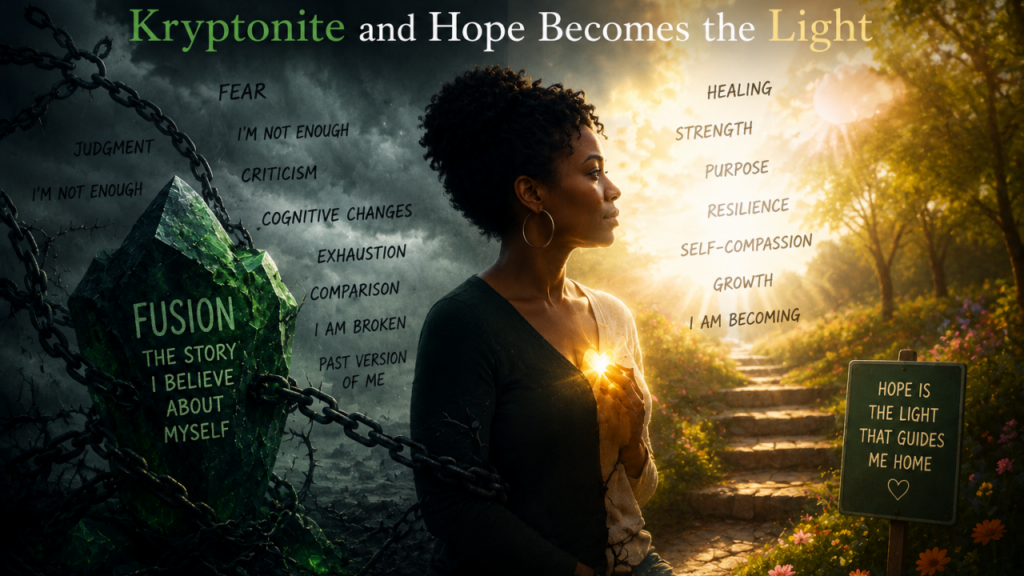
Fusion happens when a feeling, fear, or painful thought becomes so emotionally attached to us that we stop seeing it as a thought and start seeing it as the truth.
And when I look back now, I realize fusion has been quietly shaping parts of my survivorship journey for a long time.
The Invisible Side Effects of Survivorship
Cancer changed more than my body.
The chemotherapy side effects that stemmed from my Triple Negative Breast Cancer diagnosis changed how I process information, how quickly I retrieve words sometimes, how long my brain takes to recover after emotionally or mentally demanding moments, and how safe I feel in spaces where I once moved confidently.
Survivorship is not always visible. Some of the hardest side effects live quietly inside the mind.
Before cancer, I moved differently. I trusted my memory differently. I trusted myself differently.
And if I am being honest, there are still moments, even now, where I grieve the version of Shanise that existed before diagnosis.
That grief exists in both the past and the present.
How Fusion Began to Form
The emotions I felt before the panel were real:
- Anxiety
- Fear
- Disappointment
- Insecurity
My story became:
What if people notice my cognitive dysfunction? What if I sound less intelligent? What if I do not belong here?
Then came the analyzing:
Maybe people will judge me. Maybe cancer permanently changed me. Maybe I am not capable in the same way anymore.
And then came the fusion:
I am not the same Shanise I was before cancer.
The painful part is that this fusion did not develop overnight.
It was reinforced over time.
When the Workplace Reinforces the Fear
Not only through my own fears, but through real experiences that impacted how I viewed myself professionally and personally after cancer.
My cognitive struggles affected my confidence at work in ways I never expected. Comments were made that made me feel smaller. I felt judged in moments where I was already internally overcompensating. I received one of the worst performance evaluations of my career, something I had never experienced before cancer.
So over time, my brain started collecting those moments as evidence.
Evidence that maybe I was not as sharp. Evidence that maybe I was not as capable. Evidence that maybe cancer permanently changed me into someone “less than.”
That is the dangerous part about fusion.
It attaches pain to identity.
And when enough experiences reinforce the fear, the fear starts feeling factual.
Instead of:
“I am struggling with cognitive changes after trauma and treatment.”
Fusion says:
“I am inadequate.”
Instead of:
“I am healing while navigating invisible side effects.”
Fusion says:
“I am broken.”
And for a long time, I carried that quietly.
Even while advocating. Even while speaking publicly. Even while inspiring others. Even while surviving.
The Emotional Labor of Advocacy
That is another part of survivorship people do not always talk about.
- Advocacy is beautiful
- Advocacy is powerful
- Advocacy is rewarding
But advocacy from lived experience is also emotional labor.
A day in the life of an advocate who shares from lived experience means carrying your own pain while creating space for others to finally release theirs.
After the panel discussion, women approached me – some with tears in their eyes. They shared stories about medical dismissal, fear, caregiving, survival, grief, exhaustion, resilience among other sensitive and personal topics that our entire community has/will face.
What struck me most was realizing that one honest comment could unlock emotions people had been silently carrying for years.
And while those moments are deeply meaningful, they can also be emotionally heavy.
- People often see the strength
- The leadership
- The speaking engagements
- The resilience
- The inspiration
But they do not always see the emotional decompression afterward.
- They do not always see the advocate who is still actively healing herself
- They do not always see the cognitive fatigue after the panel ends
- They do not always see the anxiety before stepping onto the stage
- They do not always see the emotional crash after holding space for everyone else’s pain while still carrying your own
Sometimes advocacy unintentionally minimizes the advocate.
People begin seeing you as the message instead of the human being carrying it.
When Fusion Became My Kryptonite
And somewhere along the way, I started believing my fusion was my kryptonite.
I started believing the cognitive changes, the emotional exhaustion, the criticism, the fear, and the trauma meant I was broken.
But hope entered quietly.
- Not through perfection
- Not through pretending I was unaffected
- Not through becoming the “old Shanise” again
Hope came through realizing there is something about me that only I can truly see.
And maybe that is the part survivorship tries to teach us.
- There is a version of ourselves beneath the fear
- Beneath the grief
- Beneath the performance evaluations
- Beneath the anxiety
- Beneath the scars
- Beneath the cognitive dysfunction
- Beneath the pressure to keep inspiring everyone else
A version of ourselves that still exists even after everything.
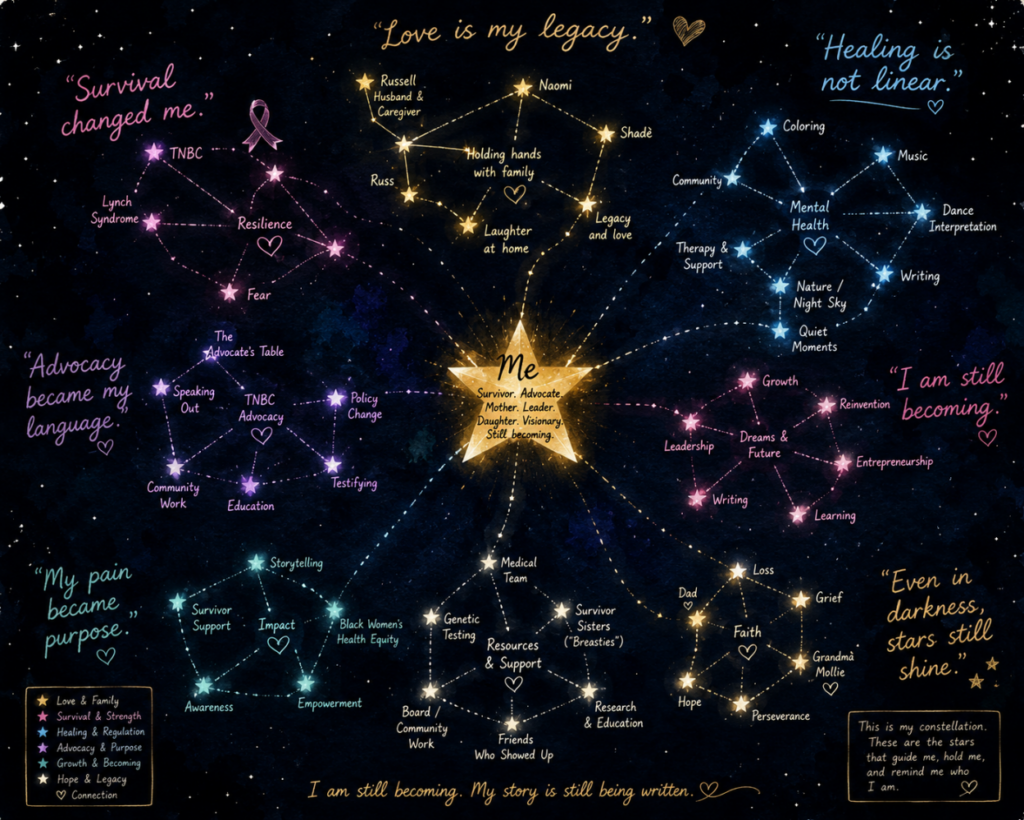
My Constellation of Hope
When I created my constellation map, I realized my life is no longer made up of only pain. Yes, there are stars connected to TNBC, Lynch Syndrome, grief, fear, survivorship, and loss. But there are also stars connected to love, advocacy, therapy, healing, writing, coloring, music, policy change, faith, laughter, purpose, and hope.
- I saw the people who held me up
- The people who showed up for me
- The women whose stories now live connected to mine
And in the center of all of it was me.
- Not perfect
- Not unchanged
- Not untouched by trauma
But still becoming.
What I Need to See
What I need to see, and what I hope other survivors begin to see too, is this:
- I am not broken
- I am evolving
The woman I was before cancer mattered. But the woman I am becoming matters too.
Maybe my hope is not found in becoming who I used to be.
Maybe my hope is recognizing that despite everything I have endured, there is still light in me that cancer could not take.
- A light that still connects
- Still advocates
- Still loves deeply
- Still shows up
- Still creates space for healing
- Still dreams
- Still becomes
When I look at my constellation now, I do not just see survival.
- I see resilience
- I see humanity
- I see purpose
- I see love
- I see connection
- I see hope
And maybe that is the most important lesson of all:
Even in darkness, stars still shine.

Leave a Reply