There are moments in the Triple Negative Breast Cancer (TNBC) community that feel bigger than medicine. Bigger than headlines. Bigger than statistics.
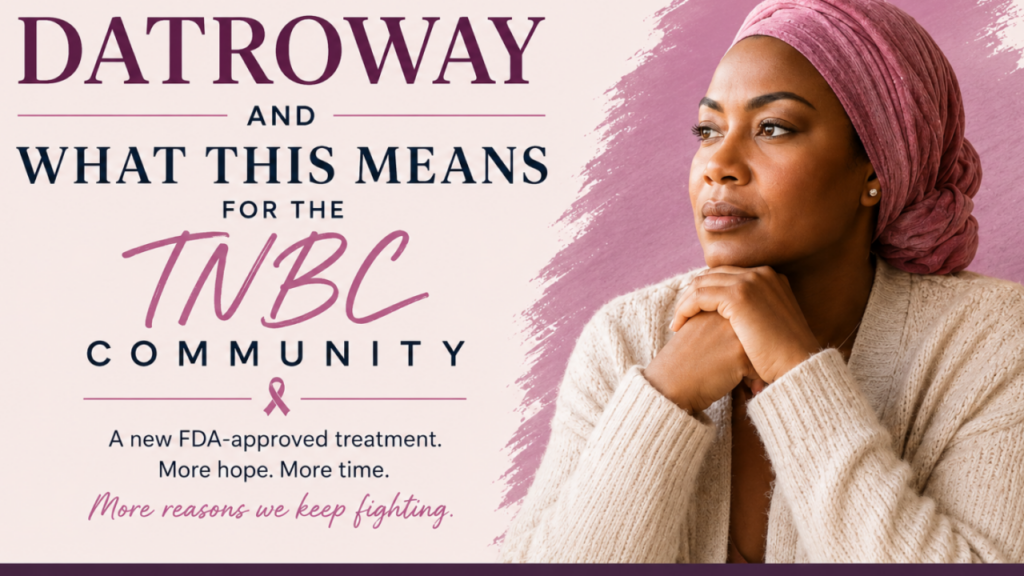
For many of us, the FDA approval of DATROWAY® (datopotamab deruxtecan-dlnk) is one of those moments.
For years, people living with metastatic or unresectable TNBC have faced limited treatment options, aggressive disease progression, and survival disparities that disproportionately impact Black women. Many patients eventually exhaust standard chemotherapy regimens and are left searching for hope in the middle of fear, fatigue, and uncertainty.
Now, there is a new treatment option entering the conversation. And for the TNBC community, that matters deeply.
What Is DATROWAY?
DATROWAY (datopotamab deruxtecan-dlnk), often referred to as Dato-DXd, is a targeted antibody-drug conjugate (ADC). Unlike traditional chemotherapy that affects both healthy and cancerous cells, ADCs are designed to act more like guided missiles by targeting specific cancer cells while attempting to limit damage to healthy tissue.
DATROWAY targets something called TROP2, a protein commonly expressed in many TNBC tumors. Once attached to the cancer cell, the medication delivers chemotherapy directly into the tumor.
This approach represents a major shift in how aggressive cancers like TNBC are being treated.
On May 22, 2026, the U.S. Food and Drug Administration approved DATROWAY for adults with unresectable or metastatic Triple Negative Breast Cancer who are not candidates for PD-1/PD-L1 immunotherapy.
This approval was based on results from the Phase III TROPION-Breast02 clinical trial.
Why This Approval Matters
Triple Negative Breast Cancer accounts for approximately 10% to 15% of all breast cancers, but it is considered one of the most aggressive and hardest-to-treat subtypes. TNBC lacks estrogen receptors, progesterone receptors, and HER2 expression, which means many targeted therapies used for other breast cancer types simply do not work here.
The statistics surrounding TNBC are heartbreaking:
- Black women are approximately twice as likely to be diagnosed with TNBC compared to White women.
- Black women with TNBC also experience significantly higher mortality rates.
- Metastatic TNBC has historically had fewer effective long-term treatment options compared to other breast cancer subtypes.
- Many metastatic TNBC patients face disease progression within months after standard chemotherapy treatments stop working.
For a community that has repeatedly heard the words “limited options,” this approval represents movement. It represents innovation. It represents time.
And in metastatic breast cancer, time matters.
The Clinical Trial Results That Turned Heads
The TROPION-Breast02 trial demonstrated significant improvements compared to standard chemotherapy.
According to published data:
Median overall survival improved to 23.7 months with DATROWAY versus 18.7 months with chemotherapy.
Median progression-free survival improved to 10.84 months compared to 5.55 months with chemotherapy.
The treatment reduced the risk of disease progression or death by 43%.
DATROWAY also demonstrated fewer treatment discontinuations compared to chemotherapy despite patients remaining on therapy longer.
For many outside the cancer community, these may look like numbers on a page.
But patients understand what those months can mean.
More birthdays. More time with children. More holidays. More memories. More hope.
Why This Feels Personal to Me
There is something haunting about living after a Triple Negative Breast Cancer diagnosis.
People celebrate survivorship, and they should. Survival matters. Remission matters. Hope matters.
But what many people do not understand is that TNBC changes the way you think forever.
Even after treatment ends.
Even after the surgeries.
Even after the scans.
Even after the bell ringing.
Even after people tell you how strong you are.
Somewhere deep inside, a part of you never fully stops wondering:
Will it come back?
That question lives quietly inside so many of us in the TNBC community.
And the truth is, many of us personally know women who did everything “right” and still watched their cancer metastasize.
We know the women whose names are now spoken in memorial posts.
The women whose children are now growing up without them.
The women who fought hard and still lost their lives to this disease.
That reality changes you.
As someone diagnosed with Stage 1, Grade 3 Triple Negative Breast Cancer, I know what it feels like to hear statistics attached to your future. I know what it feels like to sit in rooms where words like “aggressive,” “high risk,” and “recurrence” are spoken so casually while your entire world is collapsing internally.
And as a Black woman, I also know the weight of understanding that women who look like me are dying at higher rates from this disease.
That reality is impossible to ignore.
So when I hear about advancements like DATROWAY, I do not just hear medical terminology or pharmaceutical updates.
I hear possibility.
I hear another mother potentially getting more time with her children.
I hear another family maybe getting one more Christmas.
I hear another woman having access to a treatment that did not exist for the women who came before her.
And honestly, that makes me emotional.
Because for so long, the TNBC community has lived in a space where it felt like we were always behind. Watching other breast cancer subtypes receive wave after wave of targeted therapies while many of us were still cycling through harsh chemotherapy regimens and hoping for the best.
Many of us know what it feels like to cling to hope while simultaneously preparing for the worst.
That is the emotional reality of Triple Negative Breast Cancer that people rarely talk about.
You can be grateful to be alive and still terrified.
You can be in remission and still emotionally exhausted.
You can smile publicly while privately carrying survivor’s guilt for the people who did not make it.
And sometimes, treatments like DATROWAY represent more than medicine.
Sometimes they represent proof that the world has not stopped fighting for us.
That researchers are still searching.
That innovation is still happening.
That metastatic TNBC patients are still being seen.
That our stories matter enough for someone to keep pushing science forward.
The Reality We Still Must Address
At the same time, approvals alone are not enough.
Access matters.
Insurance coverage matters.
Clinical trial diversity matters.
Early detection matters.
Healthcare equity matters.
Black women continue to die from breast cancer at disproportionately higher rates despite often being diagnosed at younger ages and with more aggressive disease biology. These disparities are tied to systemic inequities involving access to care, delayed diagnosis, medical bias, financial barriers, genetics, and gaps in treatment access.
A breakthrough treatment only changes lives if patients can actually receive it.
That means the work of advocacy cannot stop here.
This is why advocacy matters to me.
Because every breakthrough treatment started with someone refusing to stop researching.
Someone refusing to stop funding.
Someone refusing to stop listening to patients.
Someone refusing to believe aggressive cancers were hopeless.
And this is also why representation matters.
Black women deserve to be included in clinical trials.
We deserve access to innovation.
We deserve earlier detection.
We deserve equitable healthcare.
We deserve to survive.
Not just statistically.
Not just symbolically.
Actually survive.
What This Means Moving Forward
DATROWAY represents something the TNBC community desperately needs: momentum.
Momentum in research.
Momentum in innovation.
Momentum in survival.
Momentum in hope.
For patients currently navigating metastatic TNBC, this approval may open doors to another treatment pathway.
For survivors, it reinforces why advocacy and research funding matter.
For families who have lost loved ones to this disease, it is another reminder that the fight for better outcomes must continue.
And for Black women especially, this moment matters because our voices, experiences, and outcomes deserve to be centered in these conversations.
If you are reading this as a survivor, caregiver, patient, advocate, clinician, researcher, or someone who simply loves a person impacted by TNBC, I hope you understand this:
These approvals are not just scientific milestones.
For many of us, they feel deeply personal.
Because every new treatment carries something this community desperately needs more of:
Hope.
Sources and References
FDA Approval Announcement https://www.fda.gov/drugs/resources-information-approved-drugs/fda-approves-datopotamab-deruxtecan-dlnk-unresectable-or-metastatic-triple-negative-breast-cancer
Reuters Coverage of FDA Approval https://www.reuters.com/business/healthcare-pharmaceuticals/us-fda-approves-astrazenecas-drug-breast-cancer-2025-01-17/
OncLive Coverage https://www.onclive.com/view/fda-approves-datopotamab-deruxtecan-for-unresectable-or-metastatic-tnbc
Targeted Oncology Coverage https://www.targetedonc.com/view/fda-approves-datopotamab-deruxtecan-for-tnbc
PubMed Clinical Trial Publication https://pubmed.ncbi.nlm.nih.gov/41937088/
DATROWAY Official Website https://datroway.com/
American Cancer Society TNBC Information https://www.cancer.org/cancer/types/breast-cancer/about/types-of-breast-cancer/triple-negative.html
Centers for Disease Control and Prevention TNBC Information https://www.cdc.gov/cancer/breast/basic_info/triple-negative-breast-cancer.htm
Breastcancer.org TNBC Information https://www.breastcancer.org/types/triple-negative-breast-cancer
American Association for Cancer Research: Breast Cancer Disparities https://aacrjournals.org/cancerdiscovery/article/12/1/31/675828/Disparities-in-Breast-Cancer-Outcomes-in-Black
Susan G. Komen Breast Cancer Disparities https://www.komen.org/breast-cancer/risk-factor/race-ethnicity/

Leave a Reply